
Social media sends billions of clicks to websites every day. But most of those clicks come from random visitors who leave within seconds.
The real goal is targeted traffic: visitors who match your audience, care about your topic, and take action on your site.
This article covers three proven methods to attract the right visitors from social media. Each method uses a different approach.
Together, they form a complete system for driving qualified traffic to any website.
The difference between general traffic and targeted traffic is simple. General traffic includes anyone who clicks. Targeted traffic includes only people who fit your ideal visitor profile. These visitors stay longer, read more pages, and convert at higher rates.
A study by HubSpot in 2023 found that social media leads have a 100% higher lead-to-close rate than outbound marketing. The key is reaching the right people with the right message at the right time.
How to Use Keywords and Hashtags to Reach Relevant Visitors
Keywords and hashtags act as filters on social media platforms. They connect your content with people who already search for your topic.
Using them correctly separates your posts from the noise and places them in front of people who want what you offer.
Start with keyword research for social platforms. Social media keyword research differs from SEO keyword research. On Google, people type full questions.
On social media, people search shorter phrases and follow topic tags. Tools like Hashtagify, RiteTag, and the native search bars on Instagram, LinkedIn, and TikTok show what terms people actually use.
For example, a fitness coach selling online programs should not just use #fitness. That hashtag has over 500 million posts on Instagram alone. Instead, specific hashtags like #strengthtrainingforbeginners or #homeworkoutplan attract a smaller but far more relevant audience.
Real case: Gymshark’s hashtag strategy. Gymshark built a billion-dollar brand partly through strategic hashtag use.
They created branded hashtags like #Gymshark66, a 66-day fitness challenge. This hashtag generated over 12 million posts. But they also used niche hashtags alongside their branded ones.
Posts included tags like #liftingcommunity, #gymmotivation, and #fitnessgains. Each tag attracted visitors who were already interested in fitness apparel and training content. This combination of branded and niche hashtags drove massive targeted traffic to their website.
Use platform-specific keyword placement. Each platform treats keywords differently:
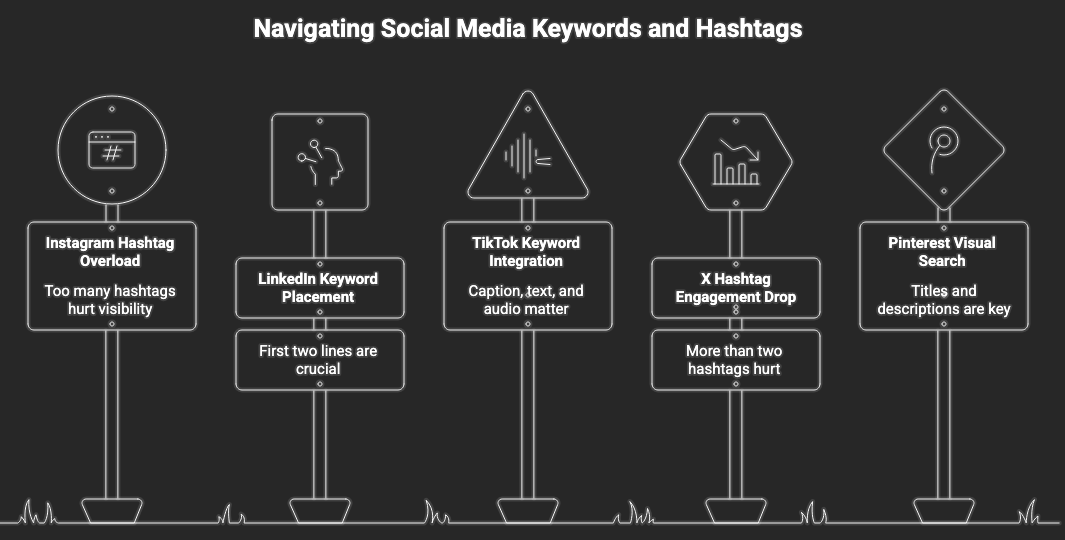
- Instagram: Place hashtags in the caption or first comment. Use 5 to 10 relevant hashtags instead of the maximum 30. Instagram’s 2024 algorithm favors fewer, more specific hashtags over large quantities.
- LinkedIn: Write keywords directly into your post text. LinkedIn does not use hashtags the same way Instagram does. Keywords in the first two lines of your post carry the most weight because LinkedIn shows those lines before the “see more” button.
- TikTok: Put keywords in your caption, on-screen text, and even in your spoken audio. TikTok’s search engine reads all three. A report from Later in 2024 showed that TikTok videos with keyword-rich captions received 30% more views from search than videos without them.
- X (Twitter): Use 1 to 2 hashtags per post. Tweets with more than two hashtags see a drop in engagement according to data from Sprout Social. Place your target keyword in the tweet text naturally.
- Pinterest: Write keyword-rich pin titles and descriptions. Pinterest functions as a visual search engine. Pins with clear, descriptive titles rank higher in both Pinterest search and Google image search.
Layer keywords with audience targeting language. Go beyond topic keywords. Include words that describe your ideal visitor.
If you sell accounting software for freelancers, use hashtags and keywords like #freelancetaxes, #selfemployedfinance, or #solopreneurtools. These terms filter out corporate accountants and attract your actual target audience.
Real case: Canva’s Pinterest keyword strategy. Canva uses Pinterest to drive millions of monthly website visitors.
Their pins use titles like “Free Instagram Story Template for Small Businesses” and “Resume Template for College Students.”
Each title contains a specific keyword phrase that matches what their ideal user types into Pinterest search. This precision attracts visitors who already need Canva’s product, resulting in high signup conversion rates from Pinterest traffic.
Track which keywords drive clicks, not just views. Use UTM parameters on every link you share. Google Analytics shows which social posts and which keywords produce actual website visits.
Review this data monthly. Double down on keywords that drive clicks and replace ones that only generate impressions.
How to Repost High-Performing Content With Stronger Click Intent
Most social media content gets posted once and forgotten. But your best-performing posts already proved they connect with your audience.
Reposting those posts with stronger calls to action turns engagement into website traffic.
Identify your top performers.
Check your analytics on each platform. Look for posts with high engagement rates: likes, comments, shares, and saves. These posts already resonated with your audience.
The content works. Now you need to adjust the format to drive clicks. A post that received 500 likes but only 10 link clicks has a content-to-click gap.
The topic attracts attention, but the post does not motivate the visitor to leave the platform and visit your site.
This gap represents your biggest opportunity.
Rewrite the hook with click intent. The original post might say,
“Here are 5 tips for better sleep.”
A repost with click intent says, “I wrote a complete guide on sleep optimization with 5 methods backed by research.
The third one changed my sleep quality in one week.
Link in bio.” The second version creates curiosity and gives a specific reason to click.
Real case: Ali Abdaal’s content recycling system. Ali Abdaal, a productivity YouTuber with over 5 million subscribers, reuses his best-performing video topics across platforms.
He takes a YouTube video that performed well, extracts the key points, and creates LinkedIn posts, Twitter threads, and Instagram carousels from the same material. Each repost includes a direct reference to the full article or video on his website.
His team reported that repurposed content drives 40% of their total website traffic. The content is proven, and the reformatted versions include stronger calls to action that push visitors to the website.
Add a content upgrade to drive clicks. A content upgrade gives visitors a reason to leave the social platform.
Take your high-performing post about “5 Email Subject Line Formulas” and add a downloadable PDF with 20 more formulas available on your website.
Mention this upgrade in the repost. For anyone looking to build a repeatable system for this process, solid targeted traffic can help you plan each step from content selection to click optimization.
Adjust the format for each platform. A Twitter thread that performed well can become a LinkedIn article, an Instagram carousel, or a TikTok video.
Each format reaches a different segment of your audience. Buffer’s 2024 State of Social Media report found that brands that repost content in different formats across platforms see a 60% increase in total reach compared to single-format posting.
Real case: Morning Brew’s reposting strategy. Morning Brew, the business newsletter with over 4 million subscribers, systematically reposts their top newsletter content on social media.
They take a popular newsletter section, turn it into a visual infographic for Instagram, and create a short video summary for TikTok.
Each repost ends with a clear call to action: “Get stories like this in your inbox every morning.
“This approach drives consistent newsletter signups from social media because their email audience has already validated the content.
Time your reposts for the largest exposure. Do not repost the same content on the same day.
Space reposts at least 2 to 4 weeks apart on the same platform. Cross-platform reposts can happen within the same week since different audiences see them.
CoSchedule analyzed over 2 million social media posts and found that the best reposting frequency is 3 to 5 times per piece of content, spread across 3 months.
Test different angles on the same content. Your original post might lead with a statistic. Your repost can lead with a personal story.
A third version can lead with a question. Each angle attracts a different subset of your audience. Track which angle drives the most clicks and use that insight for future content.
How to Boost Social Posts for Targeted Website Visitors
Organic reach on social media continues to decline. Facebook pages reach about 5.2% of their followers organically, according to Hootsuite’s 2024 data. Boosting posts with paid promotion lets you reach a precise audience beyond your existing followers.
Choose the right post to boost. Do not boost random posts. Boost posts that already show organic engagement and include a clear link to your website.
A post with strong likes and comments tells the algorithm that the content resonates. Paid promotion amplifies that signal and pushes the post to a wider but still relevant audience.
Set precise audience targeting. Every major platform offers detailed targeting options:
- Facebook and Instagram: Target by age, location, interests, job titles, and behaviors. You can also create lookalike audiences based on your existing website visitors or email list. Lookalike audiences find new people who share characteristics with your current customers.
- LinkedIn: Target by company size, industry, job function, seniority level, and skills. LinkedIn’s targeting is the most precise for B2B traffic. A SaaS company can target marketing managers at companies with 50 to 200 employees in the technology sector.
- TikTok: Target by age, gender, location, interests, and device type. TikTok also offers behavioral targeting based on video interaction history.
- X (Twitter): Target by interests, keywords in tweets, follower lookalikes, and conversation topics.
Real case: Monday’s boosted post strategy. “Monday”, the project management platform, uses boosted LinkedIn posts to drive targeted trial signups.
They create posts showing short workflow demos and boost them to audiences matching specific job titles: project managers, operations directors, and team leads at mid-size companies. Their head of paid social shared at a SaaStr event that boosted posts with demo content convert at twice the rate of traditional display ads because the content feels native to the platform.
Start with a small budget and scale winners. Begin with $5 to $10 per day on a boosted post.
Run it for 3 to 5 days. If the cost per click stays below your target (for most industries, under $2 on Facebook and under $5 on LinkedIn), increase the budget. If the cost per click is too high, stop the boost and try a different post or audience.
Use retargeting to bring back visitors. Install the Meta Pixel, LinkedIn Insight Tag, and TikTok Pixel on your website. These tools track visitors who came from social media but did not convert.
You can then create custom audiences of these visitors and show them boosted posts with a follow-up message. Retargeting audiences typically convert 3 to 5 times better than cold audiences, according to Criteo’s research.
Real case: Shopify’s retargeting funnel. Shopify runs a multi-step social media funnel. First, they boost educational content (like “How to Start an Online Store”) to cold audiences. Then they retarget people who clicked that content with posts featuring success stories from Shopify merchants.
Finally, they retarget engaged users with free trial offers. This three-step approach moves visitors from awareness to action. Shopify reported in its 2023 annual report that social media is one of its top three channels for new merchant acquisition.
Optimize your landing page for social visitors. Driving targeted traffic only works if your landing page matches the expectation set by your social post. If your boosted post talks about “5 Free Templates for Project Planning,” the landing page should immediately show those templates.
A mismatch between the social post and the landing page increases bounce rates and wastes your ad budget. Unbounce analyzed over 40,000 landing pages and found that pages with message-match (where the headline matches the ad copy) convert 30% better than pages without it.
Measure cost per result, not clicks. Clicks alone do not indicate success. Track the full journey: click, page view, time on page, and conversion. A post that generates $1 clicks but no conversions is less valuable than a post with $3 clicks where 10% of visitors sign up. Use Google Analytics 4 with UTM parameters to track each boosted post from click to conversion.
Test creative variations. Create 2 to 3 versions of your boosted post with different images, headlines, or calls to action. Run them simultaneously with equal budgets. After 48 hours, pause the lower-performing versions and shift the budget to the winner. This simple A/B testing process consistently improves results over time.
Social media offers direct access to billions of people. But access alone does not produce results. The combination of strategic keywords, smart content reposting, and precise paid promotion turns social media from a time sink into a reliable traffic source.
Each method builds on the others: keywords attract the right audience, reposted content proves what works, and boosted posts scale your winners.
Start with one method, measure your results, and add the others as you grow.