
SEO Content Analysis: A Guide to Analyze Content For SEO and The Best Tools For It
2 April 2025

Ever wondered why some websites dominate search results while others struggle to be found?
Search engine optimization (SEO) content analysis is the secret weapon that top-ranking sites use to evaluate and optimize their content for search engines.
This evaluation process helps identify strengths and weaknesses in your content, allowing you to make strategic improvements that boost visibility and drive organic traffic.
You don’t need to be an SEO expert to benefit from content analysis. By examining factors like keyword usage, readability, originality, and overall quality, you can transform underperforming pages into powerful ranking assets.
When Google recognizes your content as valuable and relevant, you’ll find it much easier to climb those search results for your target keywords.
For a more thorough guide, check out: A Complete Beginner’s Guide to SEO
What Is SEO Content Analysis, and Why SEO Experts Are Doing It?

SEO content analysis is the systematic evaluation of web content to determine how well it’s optimized for search engines and target audiences. It involves examining keywords, content quality, relevance, length, and internal linking structure to improve search rankings.
The content analysis process plays a crucial role in evaluating existing content assets and identifying issues that may impact SEO performance. This analysis is essential for generating new content ideas and aligning strategies with business goals to enhance traffic and conversions.
Good content isn’t always good SEO content. Your beautifully written page might capture interest but still fail to rank if it doesn’t align with search intent and optimization best practices.
SEO experts regularly conduct content analysis because it reveals critical issues that hurt performance. Poor keyword targeting is often the first culprit – your content might miss the terms your audience actually searches for, rendering it invisible in results.
Out-of-date content presents another common problem. Search engines prioritize fresh, accurate information, so content that hasn’t been updated in years typically underperforms against newer competitors.
Many pages also suffer from lack of depth. When your content barely scratches the surface while competitors provide comprehensive coverage, search engines will favor the more thorough resource.
Finally, bad writing undermines even well-researched content. Awkward phrasing, grammatical errors, and poor readability create negative user experiences that increase bounce rates and decrease engagement metrics.
By identifying these issues through regular content analysis, you can transform underperforming pages into ranking powerhouses. The process helps you understand what’s working, what isn’t, and precisely how to improve your content strategy.
Solving The Issue: Steps To Take When Doing SEO Content Analysis
When your content isn’t performing well, a systematic SEO content analysis can turn things around. The approach differs slightly depending on whether you’re working with existing content that needs improvement or planning new content from scratch.
For the steps, we will be splitting them into 2 parts. The first part we’ll cover the content analysis for newly published content, while the latter would be for existing content.
(New Content) Step 1: Knowing Your Target Keywords and How to Choose Them

By using Ahrefs, you can get various keyword ideas from your seed keyword. Be sure to also look through the Keyword Difficulty before attempting to rank these keywords.
Selecting the right keywords forms the foundation of any successful SEO strategy. Before creating content, you need to understand which terms your audience is searching for. This crucial first step guides all your subsequent content decisions and helps ensure you’re creating material that actually reaches your target audience.
Start by analyzing key metrics like search volume (how many people search for the term) and keyword difficulty (how hard it is to rank for). Tools like Google Keyword Planner can help you gather this data quickly. Remember to check what type of content currently ranks for your potential keywords to ensure your planned content aligns with search intent.
Looking at your competitors can reveal valuable keyword opportunities you might have missed. Pay special attention to keywords where competitors show weaknesses in their ranking positions. These “keyword gaps” often represent the perfect balance of reasonable competition and good traffic potential.
Choose keywords that balance search volume with relevance to your business. A highly relevant keyword with moderate search volume is usually more valuable than a high-volume keyword with little connection to your offerings. Consider using a simple table or spreadsheet to track potential keywords along with their metrics for easier comparison.
(New Content) Step 2: Use a Proper Content Analysis Tool

The Hemingway App helps content creators to simplify their written work. This is extremely helpful for niche topics where jargons are often used.
Finding the right content analysis tool can dramatically improve your SEO strategy. Tools like Ahrefs and Semrush offer comprehensive keyword research, competitor analysis, and content gap identification features that help you understand what’s working in your niche. These platforms also provide actionable recommendations that take the guesswork out of content optimization.
For readability assessment, the Hemingway App highlights complex sentences and suggests simpler alternatives. You’ll quickly see if your content is too difficult for your target audience to understand. Each tool has its strengths, so you might need to use a combination depending on your specific content goals.
Remember that these tools are meant to guide your decisions, not replace your judgment. The best content balances SEO best practices with genuine value for your readers. Consider investing in at least one premium tool for in-depth analysis, as the free versions often limit important features that could make a difference in your content strategy.
(New Content) Step 3: Check Topic and Content Score

Through SurferSEO, you can let the program gauge the value of your written work. The best part is that it also suggests missing NLP languages you can add to better your content.
After crafting your content, it’s crucial to evaluate how well it aligns with search intent and keyword relevance. Content scores typically range from 0 to 100, with higher numbers indicating better optimization for your target keywords. Tools like Surfer SEO can analyze your content against top-ranking competitors, highlighting gaps in your topic coverage and suggesting improvements.
Look beyond just the overall score and examine specific content elements that need work. Pay attention to keyword density, content length, readability metrics, and topic comprehensiveness. Plerdy offers visual heatmaps that show how users interact with your content, which can help you understand if your optimization efforts match user behavior.
You can improve your content score by adding missing subtopics, optimizing headings, and ensuring your content thoroughly covers the topic. Remember that a good content score doesn’t guarantee rankings, but it provides valuable guidance for creating more competitive content. Make adjustments based on the analysis, but always prioritize providing genuine value to your readers over hitting arbitrary metrics.
(New Content) Step 4: Further Optimize By Looking into E-E-A-T

Google’s E-E-A-T framework (Experience, Expertise, Authoritativeness, and Trustworthiness) helps determine content quality and relevance. Your content isn’t just competing for rankings—it’s being evaluated on how well it demonstrates these four critical factors. When optimizing existing content, examine how clearly your piece showcases subject matter expertise and author credentials.
Look for opportunities to add relevant personal or professional experiences that strengthen your content’s credibility. You can enhance E-E-A-T by including expert quotes, citing authoritative sources, and ensuring factual accuracy throughout. Consider updating author bios with qualifications and linking to reputable external resources that support your claims.
Creating value beyond what’s already available online is key to meeting Google’s “people-first” content standards. This means going beyond keyword optimization to address user needs comprehensively and uniquely. Try showcasing case studies, original research, or industry insights that aren’t widely available elsewhere.
Remember that E-E-A-T signals aren’t just about what’s on the page but also about your overall site reputation. Build relationships with respected sites in your niche to earn quality backlinks that reinforce your authority. Regular content audits focusing on these elements will help ensure your SEO strategy remains aligned with Google’s evolving emphasis on helpful, reliable information.
(New Content) Step 5: Content Enhancement With Pictures and Infographics

Images inside blog articles are amazing for SEO progression as they serve as visual aids for readers where it also providing ranking opportunities given that the images are relevant and helpful.
Visual elements are no longer just decorative add-ons—they’re essential components of high-performing SEO content. Images and infographics break up text blocks, making your content more digestible for readers who might otherwise be intimidated by walls of text. You can transform complex data or multi-step processes into easy-to-understand visuals that readers will remember long after they’ve forgotten your written words.
Well-optimized images also create additional ranking opportunities through image search, which now accounts for nearly 30% of Google search results. When creating infographics, focus on presenting clear information with a logical flow, branded elements, and properly compressed files to maintain site speed. Remember to include descriptive alt text and relevant file names for each visual element to improve accessibility and help search engines understand your content better.
Types of effective visuals for SEO include:
- Product comparison charts that highlight key features
- Statistical infographics displaying research findings
- Process flowcharts showing step-by-step instructions
- Timeline graphics for historical information
- Maps and geographical data visualization
Visual content drives engagement, encourages sharing, and builds backlinks naturally when other sites reference your infographics. By adding your logo or watermark to original graphics, you extend brand awareness even when your visuals get shared across social platforms or other websites.
(Existing Content) Step 1: Insertion of Internal Links for Stronger SEO Ecosystem

Going back and refurbishing content by backlinking to newer content can add value to older content.
Going back to your existing content and adding internal links is like connecting highways between cities on a map. When you link older articles to newer, relevant content, you create pathways for both search engines and readers to discover more of your valuable information. This strategic linking helps search engines understand the relationship between your pages and establishes content hierarchy.
Your older content likely already has some SEO authority, so by linking to newer pages, you’re passing some of that “link juice” along. This creates a stronger overall website ecosystem where pages support each other rather than competing for attention. You can identify internal linking opportunities by auditing your existing content and looking for natural connection points where topics overlap or complement each other.
(Existing Content) Step 2: Rerunning Keyword Research

Search queries for your website/page can be discovered using the Search Results function on Google Search Console. This can give you a better insight or clue to what keywords to target.
Keywords aren’t static – they evolve as user behavior changes and market trends shift. A term that drove traffic to your site six months ago might now be losing steam or facing new competition. You should regularly revisit your keyword strategy for existing content to ensure it still aligns with current search patterns.
Start by analyzing your Google Search Console data to see which terms are actually bringing visitors to your page. Look for discrepancies between what you’re targeting and what’s performing. Pay attention to your average position for different queries – this can highlight content that’s slipping in rankings and needs attention.
Search trends can change dramatically over time, making yesterday’s optimized content today’s underperformer. Use tools like Semrush or Ahrefs to validate that your targeted keywords still have decent search volume and aren’t facing overwhelming competition. This process might reveal new keyword opportunities or show that your audience has shifted how they search for your topic.
Don’t forget to check if the search intent behind your keywords has changed. What users want when typing a query can evolve – perhaps a formerly informational term now shows commercial intent in search results. Your refreshed keyword research should guide how you update your content to match current user expectations.
(Existing Content) Step 3: Check for Duplicate Content

From Ahrefs’ Organic Keywords > Multiple URLs filter, you can deep dive into which articles/posts are potentially ranking for the same keywords. This is a form of cannibalization, and there’s a high chance of duplicating content.
Duplicate content issues can silently damage your SEO efforts without you even realizing it. When identical or highly similar content appears at multiple URLs on your site (or across different websites), search engines struggle to determine which version to rank and where to direct link equity.
Finding duplicate content doesn’t require complex technical skills. Tools like Screaming Frog SEO Spider can scan your site for both exact duplicates and near-duplicates, while Copyscape helps identify if your content appears elsewhere on the web. You can also check Google’s index count of your site pages and compare it to your actual page count for potential discrepancies.
Rapid content production schedules often lead to unintentional duplication. When teams rush to publish, they might inadvertently create pages with overlapping topics, identical paragraphs, or repurposed sections without proper differentiation. This happens more frequently than you might think.
For a thorough analysis, consider using automated duplicate content checkers that examine your site’s code. These tools flag issues even when the duplication isn’t immediately visible to readers. Many SEO platforms offer this functionality, including Ahrefs’ Content Quality tool, which scans your site for potential duplicate content issues and provides actionable recommendations for fixing them.
Once you’ve identified duplicate content, implement 301 redirects from non-preferred URLs to your preferred versions. This consolidates “link equity” and ensures Google knows which page should rank. For content that must exist at multiple URLs, use canonical tags to indicate your preferred version for search engines.
(Existing Content) Step 4: Audit for Missing Meta Tags

Screaming Frog’s audit function can quickly show your domain’s pages with meta tag issues.
Missing meta tags can silently harm your SEO efforts without you even noticing. These tiny pieces of HTML code tell search engines what your content is about, but they’re often overlooked during content creation. When conducting your content audit, pay special attention to title tags, meta descriptions, and header tags (H1, H2, etc.) that might be missing or poorly optimized.
Look for these common meta tag issues:
- Missing title tags: Every page needs a unique, keyword-rich title
- Duplicate meta descriptions: Search engines penalize repeated content
- Empty alt text: Images without descriptions hurt accessibility and SEO
- Missing H1 tags: Each page should have exactly one main heading
- Oversized meta descriptions: Keep them under 160 characters
Many content management systems offer built-in tools to check for these issues. You can also use free SEO audit tools like Screaming Frog (free version scans up to 500 URLs) to quickly identify pages with meta tag problems. Once identified, create a prioritized list of fixes based on page traffic and importance to your overall strategy.
(Existing Content) Step 5: Decaying and Degrading Content

To get the difference in Clicks between months, Google Search Console can provide this insight by comparing each month’s performance. This is a good way to gauge your post’s engagement and whether users are clicking into your post.
Content decay happens when once-valuable pages lose relevance, accuracy, or performance over time. You might notice this when traffic to older blog posts drops significantly or when engagement metrics start declining for previously successful content.
Addressing decaying content is crucial for your SEO health. Google values fresh, relevant information, and outdated content can drag down your overall site performance. When you spot declining metrics for specific pages, you have two main options: refresh the content with updated information or remove it entirely if it’s no longer serving your audience.
Refreshing decaying content often delivers better ROI than creating brand new pages. You can update statistics, add recent developments, improve formatting, and enhance keyword targeting while preserving the existing backlinks and authority. For content that’s beyond salvation, a strategic redirect to more relevant pages can preserve link equity.
Regular content audits help you spot decay before it seriously impacts your rankings. Look for pages with decreasing organic traffic, rising bounce rates, or outdated information. These signal prime candidates for your content refresh strategy.
Bold text and formatting like bulleted lists, italics, and tables can make your refreshed content more scannable and engaging. This approach not only helps readers but also signals to search engines that your content remains relevant and valuable.
To learn more about driving website traffic, read: 21 Ways to Drive Traffic from Google
Recommended Extra Tools To Help With SEO Content Analysis
Beyond the major players like Clearscope and Surfer SEO, several lesser-known tools can significantly improve your content’s search performance. These hidden gems often provide unique features at competitive price points.
Here are some SEO tools to check out:
1. Grammarly’s Plagiarism Checker

Grammarly has a built-in tool that checks whether your content is directly copied from elsewhere.
Grammarly offers a powerful plagiarism detection tool that scans your content against billions of web pages with just one click. You’ll receive an originality score showing how unique your work is, along with suggestions for proper citations when needed.
The checker doesn’t just flag potential plagiarism—it also helps improve your writing by catching grammar errors and punctuation mistakes. For students and content creators, this means better grades and more credible content.
Grammarly’s plagiarism checker is particularly valuable when you’re researching competitors’ content and want to ensure your work remains original. You can quickly paste text or upload entire documents to verify your writing maintains its authenticity.
Many educational institutions trust Grammarly, with 94% of students reporting improved grades after using the service. The tool also categorizes text based on its source—whether you typed it yourself or used AI assistance—bringing transparency to your work.
Beyond plagiarism detection, Grammarly helps format citations correctly in APA, MLA, or Chicago styles. This comprehensive approach ensures both originality and proper academic integrity in everything you write.
2. ZeroGPT

ZeroGPT can give you a score to how “AI-written” is your content. It’s a smart estimation and serves as a indicator to how Google might penalize your website for AI spamming. Image Source: Semihuman.ai & ZeroGPT
ZeroGPT stands out as a popular AI content detection tool trusted by millions of users. Its primary function lets you check whether text was written by AI tools like ChatGPT or Google Bard, making it valuable for content authenticity verification. The tool visually highlights AI-generated sentences and displays the overall AI percentage in your content.
Beyond detection, ZeroGPT offers multiple complementary features. You can access a plagiarism checker, paraphraser, summarizer, grammar checker, translator, and writing assistant—all in one platform. Their advanced model is trained to recognize AI patterns across all languages with high accuracy rates.
For teams handling multiple documents, ZeroGPT supports batch processing. You can upload several files simultaneously and review the results in your dashboard. The system automatically generates PDF reports for each detection, providing proof of content authenticity when needed. For organizations requiring programmatic access, their API supports all major features, including the AI detector and content enhancement tools.
3. Frase

Quite similar to SurferSEO, Frase can help generate content briefs that is SEO-centric. This allows your articles to be more structured and readable for both Google and human readers.
Frase stands out as a comprehensive SEO content optimization tool that brings research, writing, and optimization into one streamlined workspace. You’ll find it particularly useful for analyzing search intent through its SERP Scores feature, which helps you understand what content performs well for your target keywords.
The platform offers a unified workflow that saves you time by eliminating the need to switch between different tools. With Frase, you can quickly create content briefs, use AI-powered writing assistance, and check how your content measures against top-ranking competitors. The tool also supports team collaboration, allowing you to assign documents to writers and track progress across projects.
4. Rank Math SEO
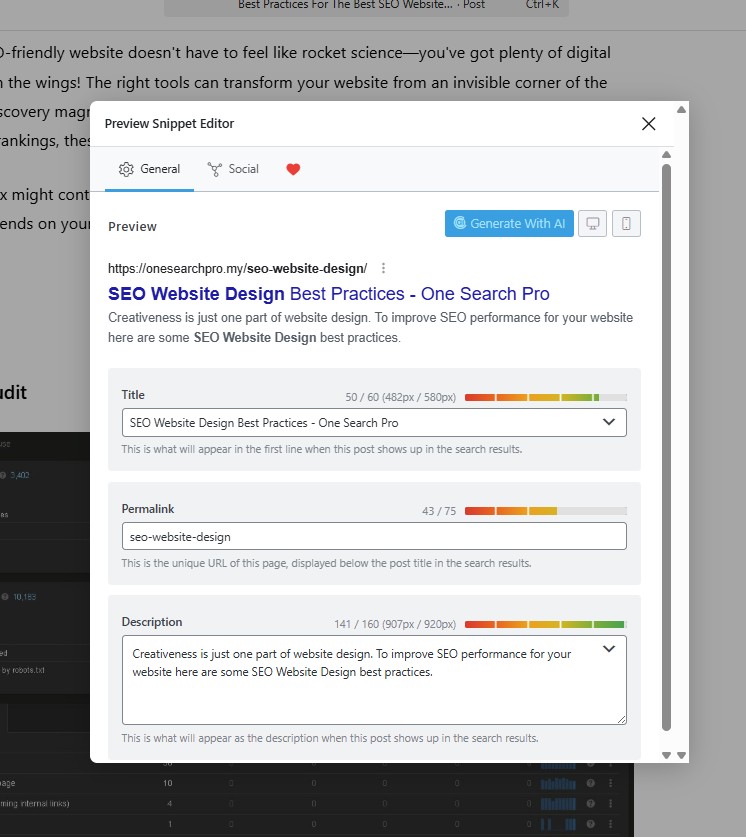
During the publishing stage of your article, RankMath SEO can give you a bird-eye view of all-things related to SEO for your blog post. It is a safety crutch for you to not “break” any SEO rules.
Rank Math is a powerful WordPress SEO plugin that transforms how you approach on-page optimization. It features an intuitive setup wizard that configures your site’s SEO settings automatically, saving you hours of manual work. The clean interface presents relevant SEO information right alongside your posts, making optimization straightforward.
You can easily install Rank Math directly from your WordPress dashboard by going to Plugins > Add New and searching for “Rank Math SEO.” Once activated, the plugin guides you through a step-by-step configuration process that sets up everything from basic SEO settings to social profiles and webmaster tools.
One of Rank Math’s standout features is its comprehensive content analysis tool that runs 30+ SEO tests on your pages. The plugin also offers advanced snippet previews so you can see exactly how your content will appear in search results before publishing. You can manage meta tags with ease while getting real-time feedback on your SEO efforts.
Rank Math integrates seamlessly with Google Search Console, allowing you to track keyword performance without leaving WordPress. The plugin supports 16 different types of schema markup without requiring any HTML knowledge, making structured data implementation simple. Performance-wise, Rank Math is designed to be lightweight, ensuring your site remains fast while benefiting from advanced SEO capabilities.
5. KeywordInsights

As an alternative to Ahrefs, KeywordInsights can also provide a SERP overview which can help you determine the search intent for a specific keyword.
KeywordInsights stands out as a powerful alternative to established tools like Ahrefs when you’re analyzing SEO content. This platform bills itself as the “World’s first Topical SEO platform” and offers some impressive functionality.
For just $1 to sign up, you get access to a tool that can generate and cluster keywords efficiently. The platform excels at mapping search intent – a crucial element for modern SEO success.
One of KeywordInsights’ standout features is its ability to produce detailed, AI-driven content briefs at scale. This saves you considerable time in the content planning process.
The keyword clustering capability helps you organize related terms logically, making your content strategy more coherent. This means you can address topics comprehensively rather than creating multiple pieces that might compete with each other.
Users praise KeywordInsights for making keyword research easier and more actionable. It transforms raw Google keyword data into practical recommendations that can directly improve your rankings.
When comparing to other keyword clustering tools, KeywordInsights consistently ranks among the top options alongside Semrush Keyword Strategy Builder, Ahrefs Keywords Explorer, and SE Ranking’s Keyword tools.
The platform particularly shines for content marketers working at scale. If you’re managing multiple content projects or large websites, the efficiency gains become even more valuable.
Getting a second opinion on your keyword strategy is always smart, and KeywordInsights offers a fresh perspective that might reveal opportunities you’ve missed with other tools.
Wrapping Up
SEO content analysis isn’t a one-time task but an ongoing process that helps your content stay relevant and competitive. Regularly examining your content’s performance allows you to make data-driven decisions about what works and what needs improvement.
Remember that keyword optimization is just one piece of the puzzle. User experience, readability, and valuable information are equally important factors that search engines consider when ranking your content.
Tools can make your analysis more efficient, but your judgment matters too. Consider the context of your industry and audience when interpreting data and making changes to your content strategy.
Still if you don’t have the knack or you want to leave the technical side of SEO to someone else, we’re here for you! Contact our SEO experts here at One Search Pro Marketing, and we’ll see to it that your blogs are rising in Google rankings!